Tuesday, March 12, 2013

Spotlight: Windsor Forest Subdivision

Windsor Forest Subdivision, Raleigh NC


This was a job than involved numerous pavement repairs - (5) Areas:


Concrete Repairs to various curbs and drain areas - (12) Areas Total:


An additional 4” Pavement Repair ordered by the customer during construction.


Thursday, March 7, 2013

Spotlight: Mattress Firm- Southern Pines, NC


 Mattress Firm Paving- Southern Pines, NC


Stage 1: Fine Grade Stone
Preparations for paving the new parking lot included fine grading, compacting, and to wet and set the stone base for paving.


Stage 2: Asphalt
Crews worked well into the night installing binder and asphalt  for the new parking lot.


Stage 3: Stripe Parking Lot and Install Signs
(42) standard parking stalls, and (2) handicap accessible parking stalls, and (2) handicap parking signs


Commercial Asphalt Paving Services Provided by Pave South/ Raleigh Paving

Choosing Pave South & Raleigh Paving is always a good investment for all your commercial asphalt paving needs including roadway paving, parking lot paving, asphalt pavement patching and repair, asphalt sealcoating and linestriping. Contact Us for more info on our commercial asphalt paving services. In addition we have a FAQ Page for paving which provides answers to commonly asked questions.

Monday, February 4, 2013

If We Can Save It, We Will!


Cold Milling, Grinding, and Pulverization

Cold Milling is the automatically controlled removal of pavement to a desired depth with specially designed equipment, and restoration of the surface to a specified grade or slope, free of humps, ruts and other imperfections. The resulting textured pavement can be used immediately as a driving surface, or it can be overlaid with a minimum of material.

Grinding is another term for cold milling. Generally the term is used with rebating. Rebating is grinding along edges where concrete curb or sidewalk meets an asphalt edge. Grinding or rebating is done to ensure there is no lip between surfaces which can be a trip hazard or unsightly.

Pulverization is a process of grinding (or milling) the existing asphalt surface and mixing it with the underlying stone base. This process serves to strengthen the existing base and form a better foundation to build on.


Cold milled materials can be recycled into the sub-base, used in the new asphalt pavement or stockpiled for use at a later time. We can often find a way to make your parking lot better and saving you money at the same time by turning the old surface into a material that can be used to build the new surface. When it comes to recycling our philosophy is that if we can save it we will. 


Cold milling can be focused on the pavement problem correcting only what is necessary saving time and money to the owner. It is done quickly with minimum interruption to the traffic flow. Cold milling is especially cost effective for large surfaces such as streets, highways, runways, community developments and large parking lots.

The Benefits of Asphalt Milling Include:
  • Restores pavement to a uniform cross-section and longitudinal profile
  • Restores drainage flow
  • Restores curb-reveal for roadways and parking areas that have had numerous overlays
  • Ruts and washboarding: Cold Milling will remove the ruts and smooth the wash boarding.
  • Deteriorating Lane: Cold milling on distressed lane will prepare it for pavement inlay while the remaining lanes need no treatment.
  • Poor bonding potential: Cold milling will provide a texture for improved bond to the new pavement.
  • Poor pavement profile: Cold milling will restore the desired profile and cross section.
  • Diminished capacity of curb and gutter: Cold milling a tapered inlay to the curb will allow for a uniform pavement match to curb and gutter.
  • Public convenience: 
  • Safety and cleanliness: The process generates no smoke or flame and the small amount of dust is easily controlled.
  • Efficiency: 
  • Energy saving: Cold milling material removed can be used again in other road resurfacing and rehabilitation.
  • Economics: This material, long thought of as a nuisance to be disposed of, is an asset with substantial dollar value. It can be used untreated as an aggregate. Reclaimed from the cold milling process has significant inherent value. Used by itself or as an ingredient in other process, it can substantially increase the scope of road rehabilitation programs.
  • Reduced cost compared to other procedures


Contact Us for more info on asphalt grinding, milling, and pulverization.
Pave South & Raleigh Paving provides asphalt grinding, milling, and pulverization services. We serve the Triangle, Triad and Charlotte metro areas of North Carolina including Raleigh, Greensboro and Winston Salem.


Wednesday, January 16, 2013

Potholes: Unforeseen Cause of Car Accidents


Potholes are a terrible thing to have for many reasons.  They can cause driving hazards, tripping hazards and create a bad impression of your place of business. Potholes can impact your business in ways you may not have considered.


Potholes are dangerous to drivers and pedestrians.  Many times people will swerve their vehicles in an attempt to avoid potholes.  This leads to them swerving towards cars and trucks in the opposing lane, or towards pedestrians on the side walk.  Either way it is a recipe for disaster.


Consider the following excerpt from  http://seriousaccidents.com in reference to hiring their car injury expert lawyers to represent persons involved in serious injury cases caused directly by potholes.


“Sometimes, when a pothole is so severe, or your car is not equipped to handle the blow, it will cause you to lose control of your car.  This leads to car accidents that, many times, have caused wrongful deaths.  Motorcycle drivers are at special risk of injury if they ride over a pothole.  Having just two wheels on the ground and a lower weight than cars, motorcycles are ill-equipped to handle potholes.  Coupled with fewer safety features, motorcycle accidents caused by potholes are very deadly.  Cars and truck are also at risk of getting into an auto accident after running over a pothole.  With motorcycles, however, the chances of getting into a serious accident when going over a pothole are greatly increased and possibly deadly.”


Justified or not, potholes are rich breeding grounds for personal injury claims against your business. Juries award plaintiffs in settlements that start in the tens of  thousands and can often reach the millions even when parties settle out of court.

If the threat of a lawsuit is not enough reason for to maintain a parking lot, loss of business might be another consideration.  It is very easy to see how much attention and maintenance a parking lot is getting just by looking at it.  Just like you know nobody is mowing a house’s lawn when the grass is high, you know when nobody is taking care of the lot when there are potholes. A well maintained parking lot is the best welcoming mat that a business can invest in.


There are many ways to repair a pothole and depending on the condition will dictate the type of repair needed. Generally 3 different approaches are taken: filling, patching and peel and pave. While there are other methods these 3 are the most common.

"Filling the pothole" consists of removing the loose material around the edges of the hole and then backfilling with asphalt. While inexpensive this type of repair does not last long and does not look good.

Patching is another common asphalt repair in areas where the asphalt has cracked, but the base is still stable, or in areas where potholes have occurred. This process begins by cleaning the repair area and applying a tack coat to help the new asphalt adhere to the existing surface. A layer of asphalt is then installed upon the existing surface; the depth will vary from 1”-2.5” depending on the severity of the existing damage. Patching is a relatively inexpensive solution to asphalt defects. Since the edges are sometimes rebated with a milling machine or a small grinder to make them straight and flush, it is far more aesthetically pleasing than the "fill the pothole" approach. Like "filling" however it is generally not a very durable repair.  

Asphalt removal and replacement or as we call it “peel & pave” is another common repair. The repair is often prescribed for areas with cracking and or base/failure. This process begins by saw cutting the perimeter of the repair area in order to achieve a clean edge. After the edges are saw cut, the existing asphalt is removed to the depth specified. Typically the new asphalt is installed in 2 lifts; a binder course usually at 3” is followed by a 1” top course. The depth of repair will vary dependent upon the extent of existing damage, and/or the load requirements needed to be met. By adding up to 10 times more life span than patch work, asphalt removal & replacement is often a very cost effective fix for your surface’s distressed areas.

For more information about patching please visit our webpage: http://www.pavesouth.com/repair.php


Friday, December 14, 2012

Crackfilling- Asphalt Vs. Nature


Crackfilling
Asphalt Vs. Nature 


Deterioration of pavement is natural.  It’s natural because over time the materials that make up the asphalt begin to break down and become more affected by elements such as rain, sunlight, and chemicals that come into contact with the pavement surface.  The liquid asphalt binder that is the “glue” of the pavement begins to lose its natural resistance to water, allowing it to penetrate into and underneath the pavement. Once this happens, the entire surface of your pavement can quickly deteriorate.  

All pavement failure starts with a crack.  There are various elements that contribute to worn out asphalt and must be stopped before it’s too late.  Just as you paint a new house to protect it from these elements, asphalt must also be protected to maximize its lifespan.  Proper attention to cracks will help prevent further asphalt deterioration and extend the wear and use of the pavement.  

The best way to handle cracked pavement is to perform a seal coat as soon as minor cracking is detected.  If that is not possible, or the cracks have grown too wide, crack sealing is a good alternative.  The use of crack sealant is a good choice for a small crack or where seal coats or overlays will be performed in the near future. The key to preserving asphalt pavement is to catch the deterioration early and perform pavement preservation techniques to eliminate or slow the damage. 


More information about crackfilling is available on our website.
www.pavesouth.com

Proper Drainage Systems


Not sure what this means?  Well, some of the most hazardous situations in your parking lot can be the result of this so let me explain.

The above equation is known as the time of concentration, or Tc.  It is the  time  in  minutes,  for  a  raindrop  to  travel  from  the most distant point in a parking lot to a concentration point (an inlet) after the beginning of rainfall.  Of course there are more equations to follow after, but the time of concentration could be considered the most vital piece of information for parking lot construction from start to finish.


The Importance of Proper Drainage Systems


Water is probably the greatest cause of distress in a paved structure.  The primary drainage function of parking lots is to convey minor storms quickly and efficiently to the storm sewer or open channel drainage with minimal impact on the vehicle/pedestrian traffic and the surrounding environment.  In addition, removing water quickly from paved surfaces will prevent water from reaching the subgrade, minimize cracks due to the weakened subgrade, and prolong the life of the pavement in a parking lot.

Site drainage is an extremely important component in the makeup of your parking lot.  Drainage in a parking area is often overlooked, but when something goes wrong, the results can be devastating.  To prevent storm water from becoming a hazard to the public and causing water damage to the structure of the pavement you should address any water issues in your parking lot immediately. When drainage issues are not attended to you can expect to see a shortened parking lot life.  Catastrophic damage can result from procrastination.


Tuesday, December 4, 2012

Types of Curbs and Their Advantages

In North Carolina, the type of curbs that are used do not vary much. "24" Curb and gutter" probably represents 90% of all curb installations in the state. But why is this? There are many other types of borders that might perform just as well if not better. As you travel north or south from North Carolina, the type of curb that is prevalent in each state varies. The look can differ slightly by changing the width of the pan or its inset radius, or sometimes the shape of the upright portion may vary too. In some instances there may not be a pan at all. The pan, if you don't know, is the horizontal portion of the "curb and gutter" system also referred to as the gutter.

To completely understand this situation, its important to understand what a curb is and why curbs are used. The National Ready Mixed Association defines a curb this way.

A curb, by definition, is something that restrains; an enclosing border or edging; a raised edge or margin; a wall; or as a verb, to strengthen or confine something. As most people think of curbs, they are raised strips of concrete along the edges of streets or parking lots. The benefits of curbs have been recognized since ancient times, and stone curbs were placed along the edges of traveled ways by early civilizations. Today's concrete curbs still provide many of the same benefits, and more.  http://www.concreteparking.org/curbs/index.html

Based on this definition, we can begin to list some of the benefits that curbs offer:

  • Help to define water flow to points of collection such as storm drains. This reduces erosion and allows water to move at lower percentages of grade.
  • Add visual appeal by providing sharp demarcations between different types of surface.
  • Strengthen the edge of flexible pavement systems such as asphalt by minimizing erosion and containing the pavement subsystem.
  • Protect shoulders by keeping traffic contained.
  • Improve the visibility for drivers.
  • Provide a protective barrier to steep drop offs.
There are other benefits to curbs but these are main reasons road authorities or owners of parking lots install curbs. However with all these benefits, shouldn't the type of curb vary by priority for a given situation? You would think so. At least I think so. 

When first arriving to North Carolina from New York State I could not understand why all the curb was the same. After all, we used to build curb to the situation. Often because of the harshness of the winters, we would add rebar , increase the thickness or put it deeper into the ground. We did valley curb, curb and gutter, upright curb, median curb and many other types of curb. On just about every job the curb detail was one of the most important details. In North Carolina, we hardly give the curb detail a second thought. Its just always the same. Why?? 

It is difficult to definitively answer this question but after having been here for 10 years now I can, at least, begin to conjecture. Perhaps it is  because 24" curb and gutter just seems to work here 95% of the time. I have seen very few situations where for one reason or another it did not work. In just about every situation across the board including mainline roads it does the job. As a result every concrete crew knows how to form and pour curb and gutter. Every curb crew with a curb machine has the standard form that meets the NCDOT spec for this curb. This brings down costs through familiarity and, in my opinion, the NCDOT and engineers throughout the state know that prices from contractors go up when they are bidding on details that are foreign to them. Over time this particular iteration of curb and gutter just seems to have won out with everybody. 


Friday, November 30, 2012

Maintenance Budgets Effected by Economic Woes


Clearly the economic woes have taken their toll on facility managers' budgets. Not only have expansion plans been tabled but normal day to day maintenance budgets for parking lots, roads and other structural surfaces have been slashed as well. It is not uncommon these days to see deteriorating conditions in parking lots getting worse because managers no longer have the resources to maximize the life of their existing facilities by doing adequate preventative maintenance.

The problem that these managers will bump up against is that the law of diminishing returns is clearly exacerbated by unprecedented inflationary factors. While the cost of oil has gone down, the cost of asphalt still is maintaining itself much higher than in the past. The net result is that if a parking lot is allowed to deteriorate beyond a certain point the costs for repair will go up exponentially.

Gone are the days of cheap overlays or large patches. Facility managers now must rely on more and better preventative maintenance rather than allow the parking lots to deteriorate to bad conditions. The adage "An ounce of prevention is worth a pound of cure" has never been so true especially when it comes to asphalt. Protect your precious investment or it will begin to cost you a lot of money. If managers want to save money they should carefully choose a contractor that will help them to get the most for their dollar. Repairs and preventative maintenance that does not hold up will simply result in wasted effort and lead to a much larger repair than you had the first time.

Paul

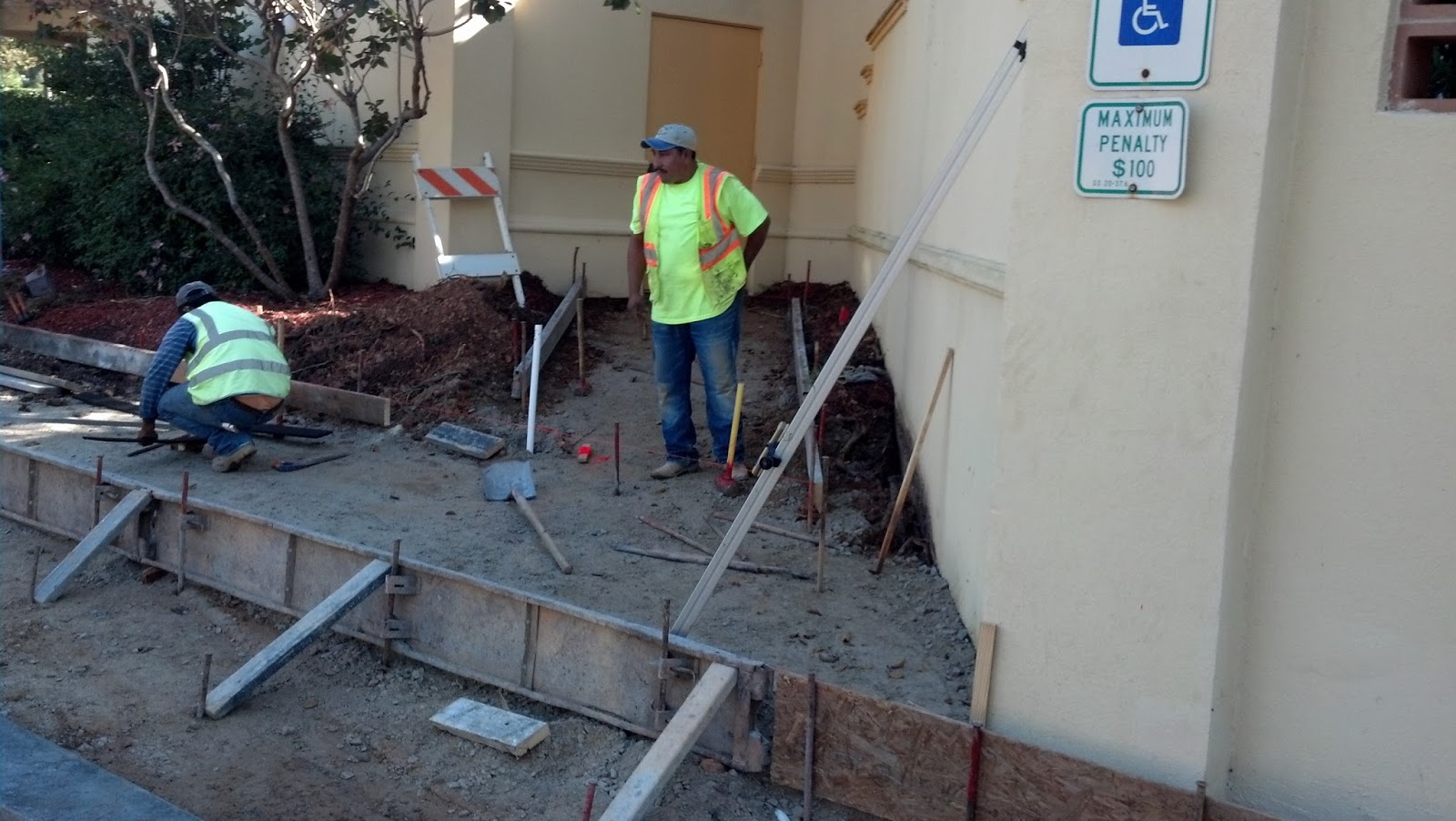
Spotlight: Laquinta and the Problem with ADA Compliance


These are the kind of comments from customers that make this job worthwhile...


"I have finally made it back down to Raleigh and was very pleased with the end results here!  Nice Job, and not the easiest one to blend back but it looks good."

"Just wanted to let you know- the client was extremely pleased with this project.  Great job on this one!    Quality work- I appreciate it!"


It always feels good when you please people. Not only from the perspective that it is a job well done but more so from the perspective that you can look forward now to the possibility of more work with these people in the future. If you have owned your own small business, you know the constant anxiety about where the next job is going to come from. Repeat business is the key to making that anxiety more manageable. 

So what was the job and what does it have to do with the title of this article? The story begins with lawyers as many of the problems with ADA compliance do. The American Disabilities Act has been around for a few years but many existing building have been around for a lot longer. As a consequence these buildings do not comply with the law as stated. Of course, these buildings are generally grandfathered in and are not forced to comply with the code unless they do updates such as expansions to the property and then generally local enforcement will try to bring the structures up to compliance. Large corporations however seem to have to live by another set of standards. The threat of lawsuit due to an injury sustained on their property is a major concern and a major focal point these days is with the accessibility requirements to and from buildings. In the past year I have spent at least 10% of my time finding ways to bring facilities as close to compliance as possible. 

The La Quinta job was a case in point. Many factors combined to make a successful completion to this job unlikely. First were the constraints set by the owner. We were expected to rip out the entire side of the hotel parking lot and walkways and rebuild the project within a week. This included curb, walk and asphalt.  On top of that we were expected to maintain compliance with ADA standards to the degree that could be achieved given the existing conditions. 

Luckily for us an engineer was involved and had produced plans that dealt with the conundrums on site but for these type of situations it is difficult to produce a perfect set of plans. To deal with these issues, we sent our survey team out there to get a better view of the site. Every step of the way there were issues to solve especially at the transitions to the tie in points. A good line of communication existed between us, the project manager, the engineer and the owner. Everyone understood the concerns and that contributed the most to a successful project. 

I don't have any epiphanies to share with you about projects like these other than communication is so important to getting the job completed on time and to the satisfaction of everyone. You can have the best experts in the world but if they are not willing to bring their expertise to the table in a meaningful way, the best jobs can turn into the worst jobs. 

My hat is off to not only to our employees who built the job but to the partnership with our customers who helped to make this job successful. 


Wednesday, March 9, 2011

Spotlight: Magna Composites Design/Build


Location: Magna Composites, Salisbury NC

Issue: The facility required an overflow parking lot in order to provide additional spaces for their ever growing employee base. They stipulated a 76 space minimum, the new lot's location, and a wish to keep costs low.


Solution: Pave South sent their surveyor to assess the initial site conditions and conduct a topographical survey. The site was designed in-house and the area of the parking lot was kept under 1 acre in order to avoid site disturbance permitting and keep costs low. We were also able to design the lot with 79 spaces, giving the facility a few more parking spaces than their minimum.


The topsoil was stripped and stockpiled on-site

The lot's earthwork was designed and calculated so as create a balance of cut to fill and avoid any costly soil export charges

The site was fine graded, abc was installed, along with a run of storm sewer along the southern edge of the lot

The asphalt was install

And the lot was striped per the customer's specifications.

Spotlight: Lone Star Steakhouse, Statesville, NC


Job: Lone Star Steakhouse Pavement Repair

Location: Statesville, NC

Issue: A large pothole had developed in the facility's parking lot and was in need of repair.


Solution:
The area was coned off for traffic control

The failed area was then saw-cut

The failed pavement was removed and the sub-grade prepped

Once the sub-grade had been prepped, it was compacted

New asphalt was then installed, compacted and re-striped.

Monday, March 7, 2011

Why do you have two names? Are you special?

Well, I guess we are special in a way. We actually have 4 names. Eastern Services is the parent company of Pave South and Raleigh Paving. Since Raleigh Paving has been around in Raleigh since 1983 and would not have much relevancy in the Charlotte market we thought it best to keep the Pave South name. Pave South will be the name of any future expansions because it is not localized. We also have another operation in the Buffalo area that goes by the name Thomann Asphalt. Thomann Asphalt has been in business since 1925 and has a strong branding in the WNY area. So in effect we have 4 names but one name that we will use in all new markets, Pave South. Hope this explains everything.

3 Qualities of a Good Contractor

I was reading another contractor's site the other day and they had an article on the 3 qualities of a good contractor. In their opinion the three main qualities are:

Reliable. Responsive. Results-Driven.


Although I think this is a good way to breakdown the issue, I kept getting it wrong everytime I tried to remember it. So I thought a better way to come up with it is to break down what they mean and then see if I can't come up with a better phrase that is easy to remember. Lets see, where do we start?

Reliable.

What is the standard of reliability or in other words what must a contractor do to be reliable. In my opinion reliability is about fulfilling commitments. So is "committed" a better term than "reliable".

According to Dictionary.com reliable means: "dependable in achievement, accuracy, honesty, etc" That is a pretty good cross section of what a contractor should be. On the other hand committed means: "to bind or obligate, as by pledge or assurance;"

While not as broad, I think there is a difference that makes me lean towards committed. The keyword here is dependable used in defining reliable. Dependable does not strike me as a word that means that you will do it every time. Contractors all claim to be reliable. It is so overused that it really has become virtually meaningless. If you asked any contractor if he is reliable he would say yes. If asked if the the contractor was reliable, references might respond something like: "Well, in general, yes". But if you ask a reference if the contractor is committed, I think that would set a different tone. In my mind if someone tells you that the contractor is "committed", it means that they strive for the highest standard possible before, during and after the job as they really stand behind what they do.

Responsive

I like this term. Responsiveness refers to communication and it is a critical part of the job process. When someone is working for me, there is nothing worse than a contractor who is non-responsive. Everything can be right but the fact that the contractor is non-responsive just leaves a bad taste in my mouth. So my vote is responsive stays.

Results-Driven

I think the meaning here refers to the end product and that the organization which includes the office, the field, the equipment or whatever is all focused on completing the end product to the satisfaction of the customer.

Answers.com defines it this way:

"A results-driven organization concentrates on meeting objectives, delivering to the required time, cost and quality, and holds performance to be more important than procedures".

Ok, I can see why they would want to use "results-driven" but like "reliable" it seems very cliche to me. Every contractor claims to be results driven but the concept is very abstract and it is not anything that you can hold your contractor accountable to. So I would like to go a different rout completely on this one and talk about a different aspect of contracting that is very prevalent in the industry, namely, change orders.

Quite frankly, the nature of contracting results in changes. We take our best guess and give you an estimate and based on that estimate as long as their are no unforeseen conditions then the price that we gave you should hold true. Changes occur for many reasons including that the customer wants to increase or decrease the scope of the work. When changes occur however, the issue of trust enters the relationship big time. So many questions can arise but in the interests of time, the customer is usually at the mercy of the contractor. In defense of the contractor, however, he may do his best to give the customer a fair an honest price but often the customer still assumes they are being overcharged. Its a difficult situation for everyone. In these instances we strive to be "fair and reasonable" since we know that the long term relationship is far more important than the short gain that can be had in these situations. But "fair and reasonable" is too long for my replacement phrase so I had to look for another word. I decided that "equitable" was the word that implied fairness, reasonability, and something else that I think goes a long way to building good relationships - objectiveness.

So there you have it. My 3 words for what a good contractor should be.

Committed. Responsive. Equitable.

Its not as appealing from a marketing perspective, but it is also not cliche and it is what you should be looking for in a contractor. We try to do more than just aspire to these ideals.